If you’ve hosted a silent auction for your nonprofit, you know these events tend to have a high return on investment (ROI) and attract a wide range of supporters—as long as your nonprofit puts in the work up front to make them succeed. To maximize your fundraising potential, you not only need to procure auction items that your unique audience is excited to bid on, but also price those items strategically.
In this guide, you’ll learn everything you need to know about how to price silent auction items, including:
- Why is silent auction pricing important?
- How to Price Items for a Silent Auction in 5 Easy Steps
- Silent Auction Pricing vs. Live Auction Pricing
Let’s get started with an overview of why it’s so critical to properly price silent auction prizes before diving into the best process for doing so.

Why is silent auction pricing important?
Just as your silent auction items have to appeal to your organization’s supporters for them to want to place bids, so does your pricing model. While some auction participants are happy to bid simply to support a good cause, others will attend in part because they hope to secure unique goods or experiences at a discounted price that they couldn’t find elsewhere.
When you price silent auction items, try to find a balance between meeting supporters’ expectations and setting your nonprofit up for the highest possible fundraising total. To accomplish this, you’ll need to do three things:
- Procure prizes that supporters will perceive as valuable (either because of their actual monetary value or because they can’t easily be found in retail stores).
- Set their starting bid at a lower amount than they’re worth.
- Encourage competitive bidding to drive the prices back up as much as possible.
Even if you take these steps, you’ll probably sell some items for less than they’re worth, which is why it’s so important to minimize upfront procurement costs by leveraging in-kind donations, nonprofit discounts, and consignment options.

How to Price Items for a Silent Auction in 5 Easy Steps
Once you’ve procured some silent auction items and are ready to start pricing them, you’ll have to do a little research and some simple math. For each item, there are four numbers you need to figure out to decide on pricing, plus one additional step to finalize the bidding process for that prize. Let’s walk through these details together.
1. Find out the Item’s Fair Market Value
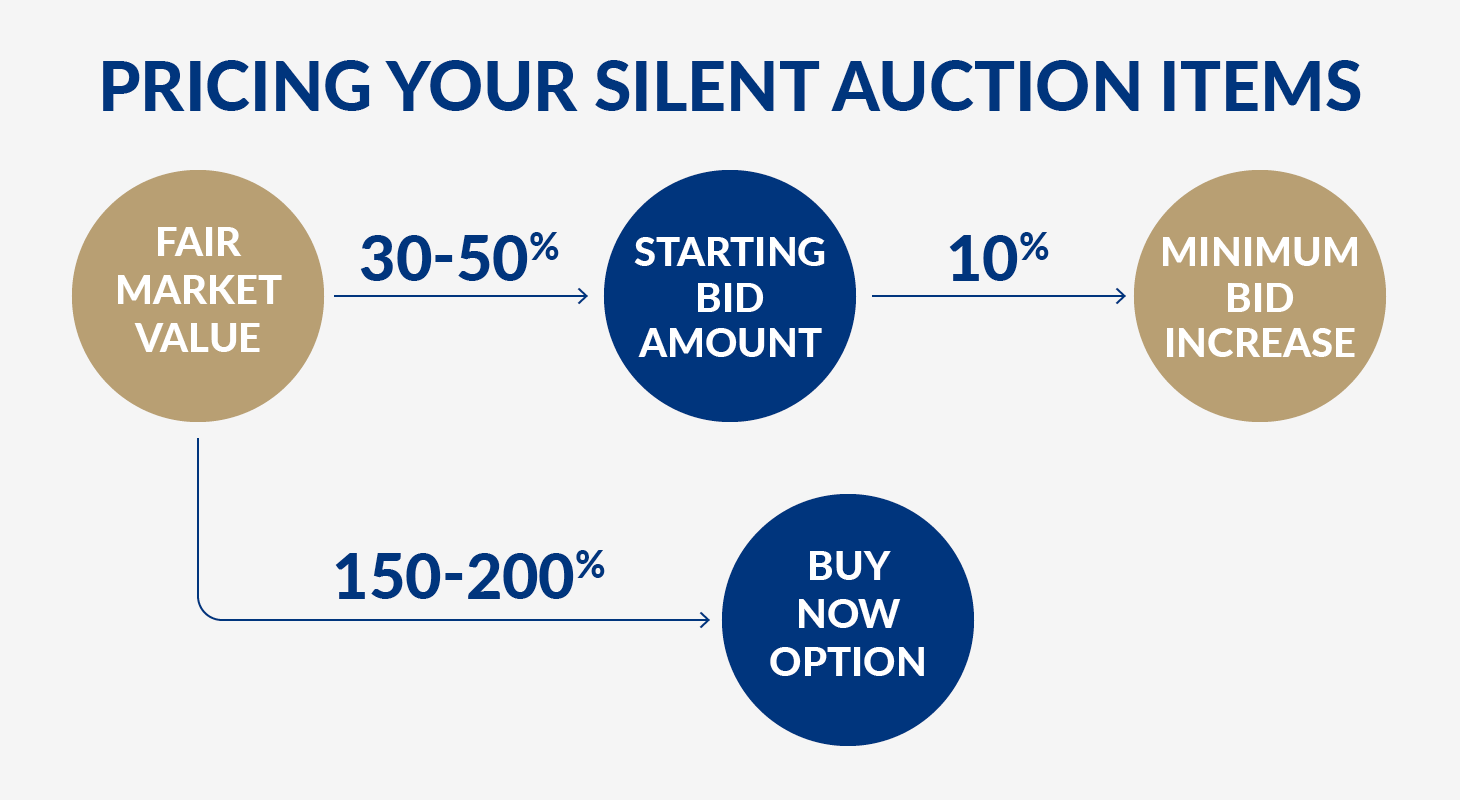
The first key number in silent auction pricing, fair market value (FMV), is the price an individual would pay for an auction item if they purchased it on the open market rather than at your event. While this value may sound straightforward, figuring it out is easier for some types of auction items than for others.
For instance, a $50 gift certificate to a local restaurant would clearly have an FMV of $50, and you can figure out a gift basket’s FMV by adding up the values of the distinct objects in the basket. But what about concert tickets that sell for different amounts across various ticketing websites, custom art pieces, or one-of-a-kind experiences like having a meal prepared by a celebrity chef?
Here are some strategies for figuring out the FMV of more difficult silent auction items:
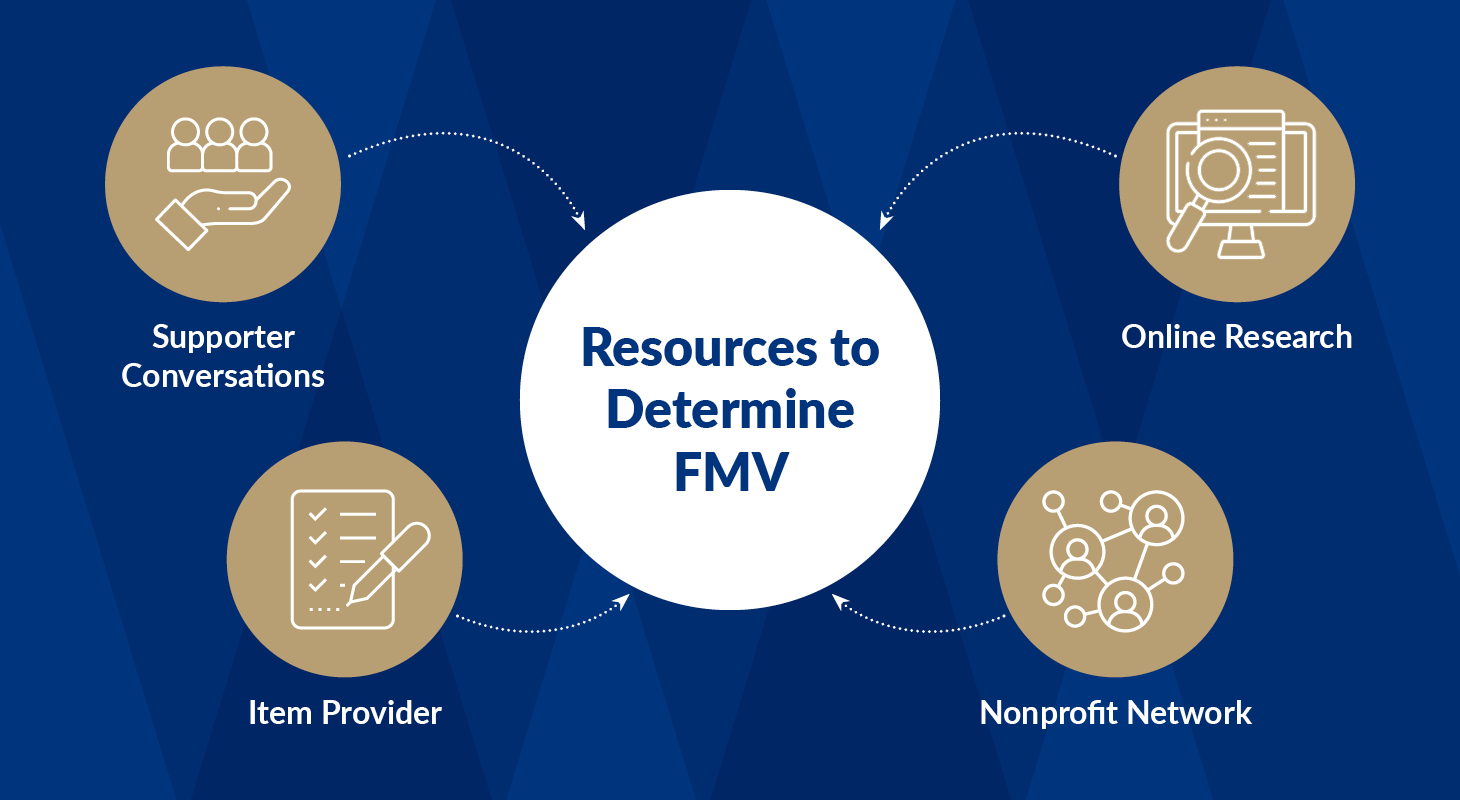
- Research comparable items online. For example, you might find that an independent artist who donated a painting to your auction is selling similar pieces through a personal website, an Etsy shop, or a local gallery. You could then estimate your painting’s FMV based on the prices they’re charging for those other pieces.
- Leverage your network. Consider reaching out to other nonprofits in your area or vertical to see if they’ve ever sold a similar auction item to one you’re having trouble pricing and, if so, what they estimated its FMV to be.
- Ask the item’s provider. The donor or sponsor that contributed an item or the venue where a ticketed event is being held may have the best insight into what your prize is worth. For unique physical goods like antique furniture or signed memorabilia, you should take the provider’s estimate with a grain of salt—some owners of these types of items may overvalue them.
- Contact potential auction participants. Because your event attendees are the ones who will purchase your auction items, it often doesn’t hurt to ask a few loyal supporters what they would be willing to pay for a behind-the-scenes tour of a movie studio or backstage passes for a Broadway musical. Plus, your conversation with them can serve as a personalized invitation to attend your event and bid on those items!
No matter which of these resources you use, do your best to make an accurate estimate. Undervaluing your auction items will cause your organization to miss out on potential funding, while grossly overestimating a prize’s FMV can create problems if the winning bidder tries to claim their contribution as tax-deductible.
2. Set the Starting Bid Amount
After you’ve determined an auction item’s FMV, you’ll need to calculate a starting bid amount next, which is the lowest amount guests can bid to win that prize at your silent auction.
For most items, your starting bid amount should be 30-50% of the FMV. Rare or unique items belong on the higher end of that spectrum, and more commonplace items should fall toward the lower end. To make it easier for auction participants to do quick mental math as they place bids, round the starting bid amount to the nearest $10, $100, or $1,000.
For example, let’s say your nonprofit secures two front-row tickets to a local concert featuring a popular artist, along with a gift certificate for merchandise and a photo opportunity with the artist after the show. You determine that the total FMV of this package is $1,000. The photo opportunity makes this prize unique, so you’d want to set the starting bid around 50% of the FMV—and 50% happens to be a nice round number in this case, $500.
The one exception to this rule is consignment items like Winspire’s travel Experiences. When you sell these prizes at auction, the money you make above the list price goes toward your mission, so your starting bid amount should be 100-120% of that price to ensure you can exceed it. For example, if you used Winspire’s Tuscany Culinary Escape vacation package in your auction, you could set the starting bid at $4,000, a round number that is just under 110% of the Nonprofit Cost (list price) of $3,660.
3. Determine the Minimum Bid Increase
Deciding on the third key number in the silent auction pricing equation, the minimum bid increase, is also a balancing act. You have to set it high enough to ensure substantial jumps (so participants aren’t outbid for a high-value item by $1) but still keep it relatively low so the bidding process is competitive.
Consider setting each item’s minimum bid increase at approximately 10% of its starting bid amount. Unlike with starting bids, the more valuable an item is, the lower its minimum increase should be so supporters see the next level up as still being relatively accessible. For instance, if you set a gift basket’s starting bid amount at $50, a 10% increase would be $5, which would make sense.
However, there are exceptions to this standard as well. Returning to the example of the Winspire trip to Tuscany, 10% of that prize’s starting bid amount of $4,000 would be $400. If you set a minimum bid increase that high, you run the risk of quickly hitting the point where supporters no longer want to bid on the item due to its cost. A lower minimum increase (e.g., $300 or even $250) can be more effective to keep the competition going.
4. Decide if You Should Add a “Buy Now” Option
“Buy Now” options give passionate silent auction participants the opportunity to purchase items they really want outright. It isn’t wise to do this for every item because bidding stops when a supporter takes the option, which can disengage other guests. However, it can help you maximize your earnings on your highest-value or most original prizes.
To make sure you profit from any items with this option and set the barrier to entry relatively high, make your “Buy Now” price 150-200% of an auction item’s FMV.
Returning to the examples above, the gift basket with the starting bid amount of $50 (making its FMV about $120-$140) is probably too commonplace and low-value to be a good candidate for a “Buy Now” option. However, the concert tickets with the photo op and the Tuscany trip might warrant one, as both prizes are high enough in value that your organization could profit significantly from them. Plus, a supporter who has been dreaming of meeting that particular artist or traveling to Italy may jump at the chance to secure those items no matter the cost.
Using the above pricing formula, you could set the “Buy Now” options for those two items at $2,000 for the concert tickets and $7,000 for the Tuscany Experience.
5. Lock in the Price & Bidding Information
Once you’ve finished all of your calculations, your last step is to add each item’s pricing information to its bid sheet, essentially locking in the price. When you do this, make sure to:
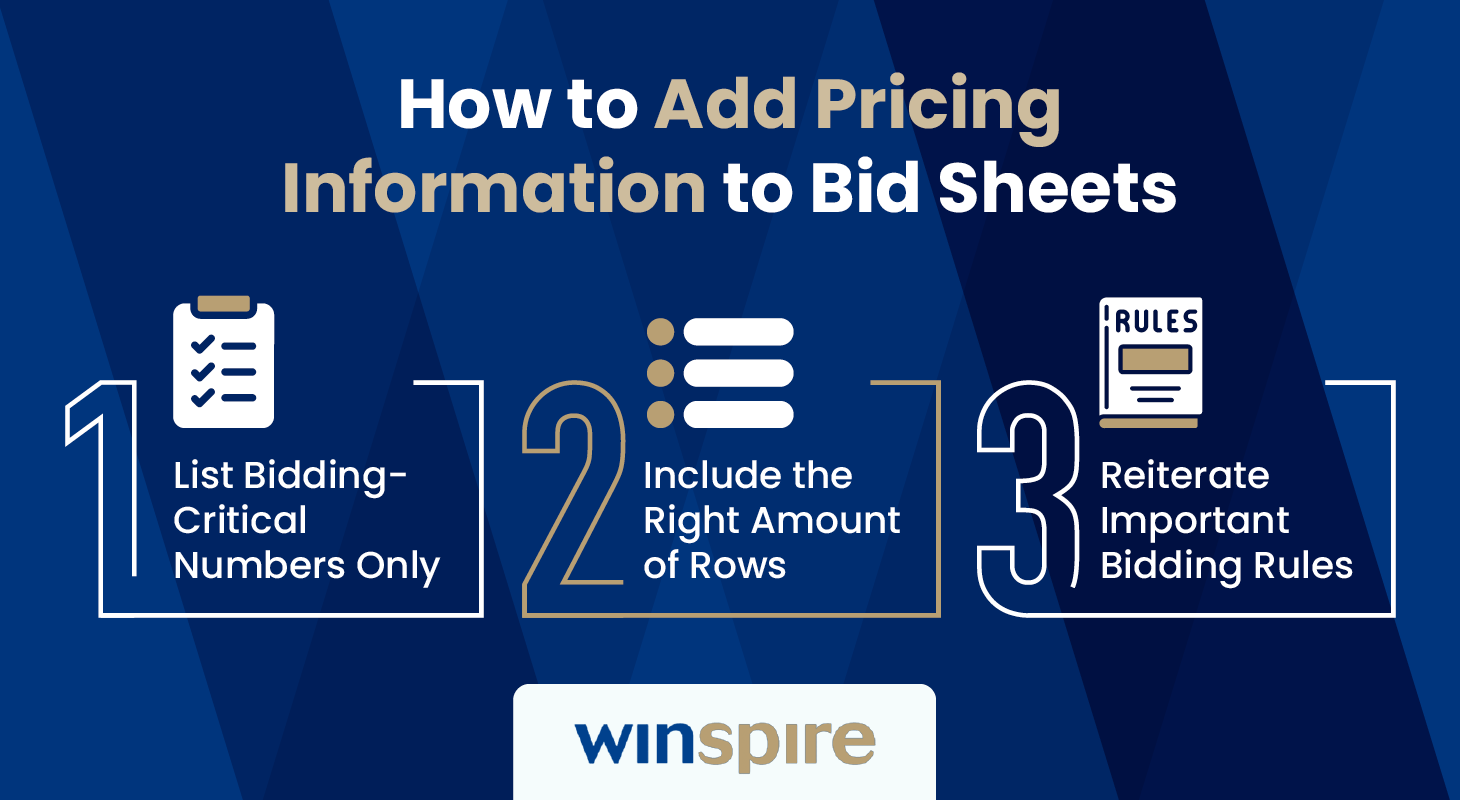
- List bidding-critical numbers only. Adding an item’s FMV to its bid sheet can inadvertently create a ceiling for bidding, so it’s best to just feature the starting bid amount and minimum bid increase at the top of each sheet.
- Include the right amount of rows. In the main section of each bid sheet, you should have at least 15 rows to promote competitive bidding. “Buy Now” sections should usually feature just one row, unless you can sell a prize multiple times (which is possible with all of Winspire’s Experiences!).
- Reiterate important bidding rules. Although participants should sign a copy of your full silent auction rule sheet during registration or check-in, you may want to remind them of some rules (what counts as a valid bid, whether participants can change or withdraw their bids, when the auction closes, etc.) throughout the event via your bid sheets.
Naturally, this process will vary depending on whether you create paper bid sheets or use event fundraising software with mobile bidding tools, but the basic principles of encouraging competition while keeping the auction running smoothly are the same across the board.
Silent Auction Pricing vs. Live Auction Pricing
Now that you know how to price silent auction items, you might be wondering about live auction pricing, especially if you’re hosting a silent and live auction during the same event. While the basic process works similarly, there are a few differences in the pricing strategy for silent vs. live auction items:
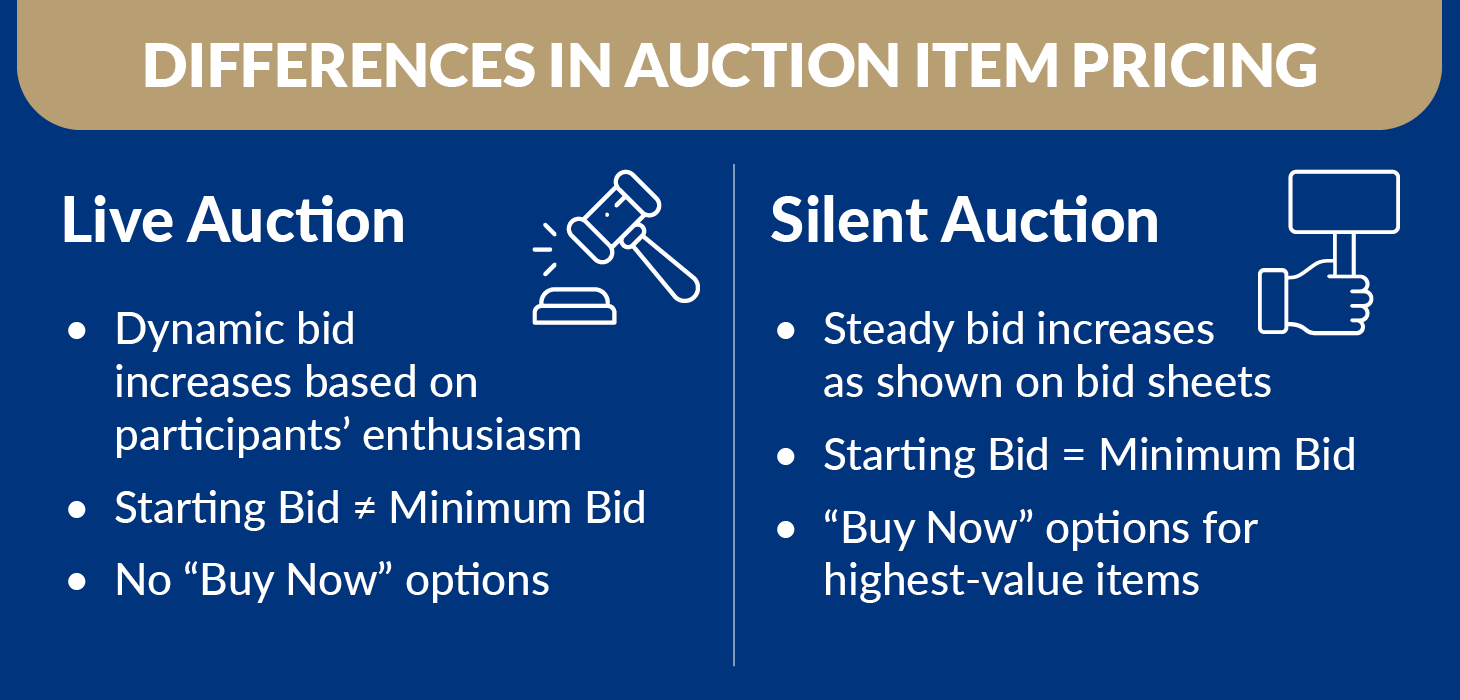
- Live auction participants tend to bid more impulsively than silent auction attendees because the bidding moves much faster. Therefore, bid increases may change in real time depending on supporters’ enthusiasm about a prize.
- In addition to a starting bid amount, you’ll need to assign each live auction item a minimum bid, which is the lowest amount you’ll let that prize go for (usually 15-25% of an item’s FMV). If no one takes the starting bid, the auctioneer can work backward to the minimum bid until someone bids.
- There should be no “Buy Now” option for live auction items because bidding wars are even more necessary to keep live auction participants engaged. Plus, all of your live auction prizes need to be relatively high in value since you’ll only have 12-15 of them in your catalog.
You should calculate starting bids and minimum bid increases for live auctions similarly to the silent auction formula (30-50% of FMV and 10% of the starting bid respectively). However, if you recruit a good auctioneer, they’ll be able to read the room and adjust pricing on the fly to ensure all of your live auction prizes sell.
How to Price Silent Auction Items: The Bottom Line
Pricing your nonprofit’s silent auction items is both a science and an art. By leveraging the formulas and tips in this guide, you’ll be well on your way to maximizing your auction’s fundraising potential while ensuring fairness to participants. And if you need help along the way, don’t hesitate to reach out to experts like our team at Winspire!
For more information on auction item pricing, check out these resources:
- Setting Starting Bids for Nonprofit Live Auctions: FAQ Guide. Dive deeper into live auction pricing strategy and get any additional questions you may have answered.
- How to Craft a Silent Auction Donation Request [+ Template]. Discover tips and resources for requesting silent auction items (and pricing information!) from individual donors and corporate sponsors.
- Top 10 Types of Charity Auction Items + Tips to Procure Them. Explore the categories of nonprofit auction items that tend to sell best—and therefore, that you’ll need to price correctly to ensure your fundraiser’s success.


Jason Champion – Vice President of National Accounts at Winspire
Jason Champion is the Vice President of National Partnerships at Winspire, a global provider of bucket-list vacation experiences for charity auctions and fundraisers. He is responsible for overseeing and managing relationships with major clients and partners across the country, which involves developing and executing strategic plans to drive revenue growth, expand market share, and ensure client satisfaction. Jason also collaborates closely with Winspire team members in sales, marketing, and other relevant departments to align business objectives with customer needs.
