The 2026 Fundraising Outlook Report reveals that an impressive 77% of nonprofits met or exceeded their 2025 event fundraising goals. But with donor fatigue and engagement also cited as common challenges in the same report, finding the right items is essential to make that continued success possible. So whatever you put up for bid needs to feel like something people genuinely couldn’t get on their own. That’s the appeal of consignment auction items—you get polished, high-end packages with less effort and risk required upfront.
In this guide, we’ll cover everything you need to know about sourcing, pricing, and presenting consignment auction items, including:
- Consignment Auction Items: Frequently Asked Questions
- Strategies for Managing Consignment Auction Items
- Explore a 100% No-Risk Consignment Model With Winspire
Let’s get started by answering some of the most common questions nonprofit event planners have about consignment auction items.

Consignment Auction Items: Frequently Asked Questions
What are consignment auction items?
Consignment auction items are typically high-value prize packages provided by a third-party vendor. The defining factor of consignment packages is that your nonprofit doesn’t purchase them up front. Instead, the vendor sets an agreed-upon cost, and the organization only pays if the item sells above that amount. Everything above that cost then goes directly to your cause.
Consignment is a low-barrier way to offer premium items that would otherwise be expensive and difficult to secure for most organizations, and it keeps your financial vulnerability to a minimum from the start.
Is there any financial risk to using consignment items?
Very little, when done right. A reputable consignment model is 100% no-risk because it requires no upfront costs. If a consignment travel package carries a base list price of $2,500 and it doesn’t meet your minimum reserve price—or doesn’t sell at all—no transaction takes place, meaning you only pay for the packages you successfully sell at your event.
By setting a minimum reserve price that’s greater than the package’s value, you ensure you’ll earn revenue from it, and every dollar raised above that base price goes directly to your mission.
That said, it’s worth understanding a consignment provider’s full terms before you commit (more on this later!).
How do you price consignment items for a charity auction?
Your starting bid for a consignment prize should sit just above the item’s base list price, guaranteeing your organization makes a profit as soon as the very first bid is placed. A strong best practice is to set your starting bid at approximately 120% of the consignment cost. Because every dollar raised above that base amount goes directly to your cause, this strategy ensures you can comfortably cover the item and maximize your fundraising revenue.
What are the best types of consignment items for fundraisers?
Travel packages are always a massive draw for live auctions, capturing supporters’ imaginations and driving engagement. While securing fully donated, luxury trips can be a complex puzzle to piece together on your own, consignment offers a seamless and cost-effective solution.
It empowers your nonprofit to offer breathtaking, highly coveted travel experiences with absolute ease. Instead of spending time coordinating scattered discounts, you can leverage a no-risk consignment model to feature curated, bucket-list trips that thrill your supporters and elevate your event.
Here are a few ideas for consignment packages you might feature:
- International travel. Curated, hassle-free trips to bucket-list destinations like Italy, Ireland, and Costa Rica.
- Domestic getaways and beach resorts. Weekend escapes, tropical villa stays, and regional wine country excursions.
- VIP sports experiences. Premium tickets to championship games, athletic packages with reserved parking, and athlete meet-and-greets.
- Culinary & wine tours. Vineyard tastings, private chef dinners, and cooking retreats.
- High-energy entertainment.Broadway weekends, music festivals, and awards show access.
- Bucket-list adventure travel. Luxury safaris, private yacht charters, and premium ski or expedition packages.
While popular gift baskets or certificates for local services are great revenue drivers, they are best secured through in-kind donations or nonprofit discounts, as those options cost even less upfront. Save consignment providers for the wow-factor travel experiences that your procurement committee couldn’t easily source for free.
Strategies for Managing Consignment Auction Items
Now that you know what types of items work best for consignment, the next step is maximizing their potential at your auction. Utilizing these packages requires careful planning so they capture participants’ attention and drive the highest possible bids. To ensure your consignment items succeed, keep these five essential strategies in mind.
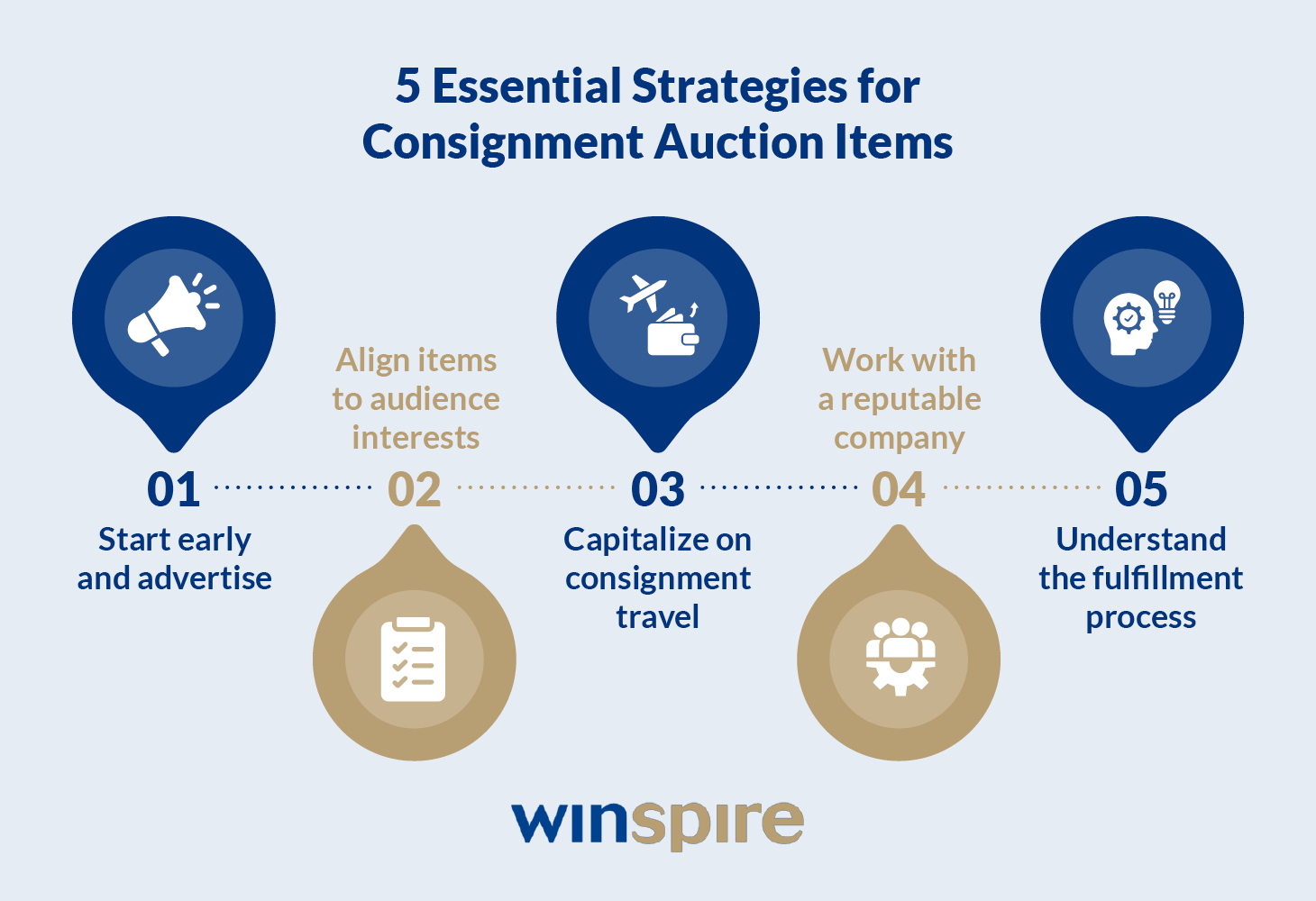
1. Start early and advertise
Treat your premium consignment packages as marketing assets. Securing multiple high-end packages gives you compelling content to promote weeks before the event. Showcasing these items early on is a fantastic way to build momentum, increase registrations, and drive excitement leading up to the big day.
When you build your marketing strategies for your event around big-ticket items, you’re doing more than generating buzz because you’re giving competitive participants a reason to show up ready to bid. A few ways to put that item to work early:
- Email campaigns. Feature item photos in your invitation and event reminder emails with compelling descriptions accompanying them. Some messages may even mention the prize in the subject line to encourage supporters to open them.
- Social media. Countdown posts and destination spotlights drive registrations and get people talking ahead of the event.
- Event landing page. Feature prizes prominently so supporters can’t miss them as they read your event details and click the signup button.
- Sponsor outreach and print communications. Give your top supporters an early look. Featuring your premium items in early mailers or direct sponsor packets builds VIP excitement and can influence early registrations and sponsorships.
The earlier you start promoting your top items, the more competitive your event will be, and the more bids you’ll get.
2. Align items with audience interests
Before you finalize your lineup, spend time thinking about who may be in the room, what they value, and what they enjoy. That way, you can match your auction catalog to your audiences’ interests and increase engagement.
Spending capacity matters as much as preference. Match big-ticket items’ price tier to what your attendees can realistically reach, and build the rest of your catalog with a range of entry points.
Here are a few ideas for matching items to target audience’s interests:
- Young professionals. Entertainment packages, culinary experiences, and weekend getaways at accessible price points
- Sports-focused audiences. VIP game packages, fantasy camp experiences, and signed memorabilia
- Community and family-oriented crowds. Domestic travel, theme park packages, and local culinary or cultural experiences
- Mixed or multigenerational rooms. A tiered catalog with one premium anchor, several mid-range experiences, and entry-level silent auction items to keep broad participation high
Giving history, past auction data, and even a quick conversation with a few trusted donors before the event can sharpen your instincts considerably. Your goal is to fill your catalog with things your supporters will actually compete for.
Try this interactive tool to match catalog items to audience types:
3. Capitalize on consignment travel
If there is one category that consistently raises paddles and eyebrows, it’s travel. A well-chosen travel package gives donors something they genuinely want and can’t easily replicate on their own—and that perceived exclusivity is one of the strongest bidding drivers you have.
If there’s one category that consistently raises paddles and eyebrows, it’s travel. A well-chosen travel package gives donors something they genuinely want and can’t easily replicate on their own. Beyond the wow factor, travel packages unlock one of the most lucrative and underused tactics in auction fundraising: selling multiples.
Here’s an example of how it unfolds during a live auction:
- Two bidders compete for a premium travel package, like a trip to Ireland.
- The auctioneer pauses before declaring a winner and directly acknowledges both active bidders.
- The auctioneer offers the same package to both at the current bid price, framing it as a rare opportunity for each of them to win.
- Both agree. The item is sold twice, at the same price, with zero additional inventory.
- Your nonprofit’s net revenue on that single item just doubled without sourcing anything extra.
While this example is for a live auction, selling multiples could also work for a silent auction, a raffle, or a combination of these fundraising activities (for example, selling a package once during a silent auction and once during a raffle at the same event).
Brief your auctioneer on this tactic before the event. Identify your top two or three travel packages as candidates to sell multiple times. Make sure your emcee is comfortable with the language. The setup takes five minutes and can generate thousands of dollars in additional revenue on auction night.
4. Work with a reputable company
Consignment may sound simple, but the vendor you choose has a direct impact on your organization’s event outcome. While a positive consignment relationship can elevate the supporter experience and bring you a big step closer to your fundraising goal, issues like misrepresentation of items, unclear fee structures, or post-event roadblocks can damage trust among participants. Most organizations don’t think about vetting until something goes wrong. Don’t wait.
You should carefully vet any consignment vendor before committing to a partnership. During this process, get clear answers to these questions:
- What are the full vendor fees? Get the complete cost structure in writing, including any handling, shipping, or administrative charges.
- What’s the policy if the item doesn’t sell? Confirm explicitly what you owe (if anything) when a minimum cost isn’t met.
- Can you provide references from nonprofits you’ve worked with? A trustworthy vendor will have testimonials readily available.
- How are items authenticated? For memorabilia, especially, know exactly who verifies provenance and what documentation accompanies the item.
- What’s the dispute resolution process? Know how issues are handled before you need to find out the hard way.
Verified authenticators, transparent pricing, and a documented track record with nonprofits aren’t nice-to-haves—they’re the baseline. If a vendor can’t answer these questions clearly, that’s your answer.
5. Understand the fulfillment process
Winning a prize is just the beginning of a participant’s consignment experience. What happens after the auction closes is where their confidence and enjoyment is (or isn’t) cemented.
Some vendors hand the winning bidder a generic voucher and leave them to sort out the rest on their own. However, a premium experience should come with real support—destination planning, booking coordination, and a point of contact if anything goes wrong. That’s what comprehensive fulfillment looks like, and it’s what keeps supporters excited about attending your events again in the future.
When evaluating vendors, ask specifically what the post-event experience looks like for winners so you understand what your participants can expect and factor it into your decision-making process.
Explore 100% No-Risk Consignment Model With Winspire
Implementing a successful consignment strategy just takes the right partner. Winspire’s 100% no-risk model is built to put these exact strategies into motion. Here is how the process works from selection to fulfillment:

- Select your ideal experiences. Browse our extensive digital catalog and add your favorite travel packages to your online Suitcase at no upfront cost. Our Event Fundraising Specialists make it easy to execute Strategy 2 (Aligning to your audience) by helping you pick the best auction items that match your supporters’ interests and spending capacity.
- Promote the items to your supporters. Put Strategy 1 (Start early and advertise) into action easily once you’ve picked your packages. Winspire provides complete marketing toolkits containing high-resolution imagery and detailed copy so you can market your Experiences across digital and print channels.
- Offer the packages at your event. Capitalize on the appeal of travel during your live or silent auction. Knowing that every dollar raised above the Nonprofit Cost (your list price) goes to your cause, your event team has the perfect, risk-free inventory to confidently execute selling multiples (Strategy 3) when a bidding war breaks out.
- Let the winning bidders redeem their packages. Delivering on the promise of complete fulfillment (Strategy 5), our full-service concierge team takes over once the event wraps up. We handle all of the booking, logistics, and coordination for the winning bidders, ensuring they have a smooth post-auction experience with no extra work for your staff.
Planning an auction is stressful enough—and we believe sourcing your inventory shouldn’t add to it. Because Winspire uses a 100% no-risk consignment model, you only cover the cost of the experiences that actually sell. With this approach, we’ve helped nonprofits across North America raise more than $110 million for their missions since our founding in 2008!

Wrapping Up: Additional Resources on Auction Planning
Consignment auction items address one of the biggest concerns nonprofit fundraisers face: investing in something that might not pay off. With the right strategy, a trustworthy vendor, and items that actually resonate with your audience, they can become the highest-earning pieces in your entire catalog, and some of the easiest to procure.
Check out these articles for more auction and event resources:
-
- How to Create Effective Bid Cards for Auctions + Template: Dive into this complete guide to discover the essential elements of a successful bid card, and download a free, customizable template to streamline your checkout process.
- The Ultimate List of 100+ Silent Auction Item Ideas for 2026: Browse this comprehensive catalog of top-performing silent auction items—from budget-friendly local goods to high-value travel experiences—and start sourcing prizes your audience will love.
- 60+ Exciting Raffle Basket Ideas for Fundraisers in 2026: Browse this comprehensive catalog of top-performing silent auction items—from budget-friendly local goods to unique physical prizes—and start sourcing fully donated items to supplement your risk-free consignment packages.

Jason Champion – Vice President of National Accounts at Winspire
Jason Champion is the Vice President of National Partnerships at Winspire, a global provider of bucket-list vacation experiences for charity auctions and fundraisers. He is responsible for overseeing and managing relationships with major clients and partners across the country, which involves developing and executing strategic plans to drive revenue growth, expand market share, and ensure client satisfaction. Jason also collaborates closely with Winspire team members in sales, marketing, and other relevant departments to align business objectives with customer needs.